How To Calculate Reaction Quotient Chemistry By So Jung Lee
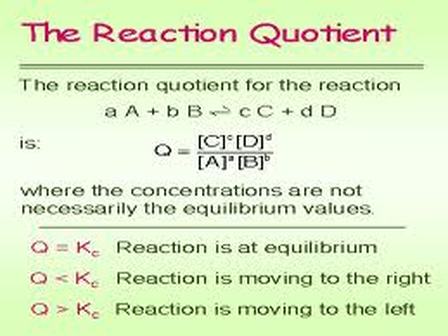
The reaction quotient (q) measures the relative amounts of products and reactants present during a reaction at a particular point in time They are removed from the complete ionic equation to get the net ionic equation The reaction quotient aids in figuring out which direction a reaction is likely to proceed, given either the pressures or the concentrations of the reactants and the products.
Reaction quotient:Notes on Reaction quotient
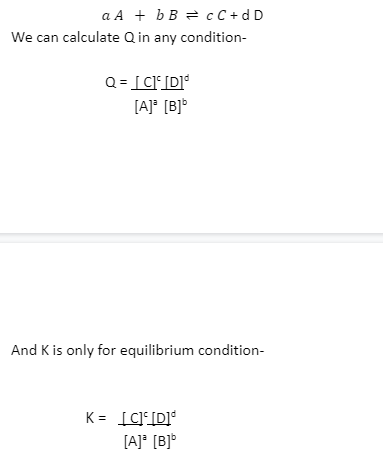
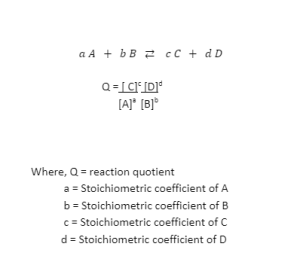
Calculating the reaction quotient, q the expression for the reaction quotient, q, looks like that used to calculate an equilibrium constant but q can be calculated for any set of conditions, not just for equilibrium Spectator ions spectator ions are ions that do not take part in the reaction Q can be used to determine which direction a reaction will shift to reach equilibrium.
Ap chemistry — reaction quotient and equilibrium constant
Learn how q and k expressions are written and how comparing them predicts the direction of a reversible reaction. The reaction quotient is a quantity used in chemistry to understand the progress of a chemical reaction with respect to the equilibrium state In a reversible chemical reaction, the concentrations of the chemical species vary, with reagents transforming into products and vice versa. The relative amounts of reactants and products present during a reaction at a specific time are determined by the reaction quotient (q)
The reaction quotient assists in determining which direction a reaction is likely to go given the pressures or concentrations of the reactants and products The reaction quotient q is a measure of the relative amounts of products and reactants present in a reaction at a given time. Use the reaction quotient (q) calculator to find qc or qp from species concentrations or partial pressures Advanced reaction quotient calculator to determine qc and qp values for chemical reactions and predict reaction direction relative to equilibrium
Compare reaction quotients with equilibrium constants to analyze whether reactions will proceed forward or reverse
Apply le chatelier's principle and thermodynamic principles to predict system behavior Essential for chemistry students, researchers. The reaction quotient, q, is a fundamental concept in chemistry with significant practical applications in various technological domains By understanding how to calculate q and interpret its value in relation to the equilibrium constant, scientists and engineers can predict reaction direction, optimize chemical processes, and develop new technologies
Reaction quotient (q) calculator calculates reaction quotient (q) which is a value that helps determine the direction in which a chemical reaction will proceed This mathematical tool is crucial in the field of chemistry, allowing scientists, students, and researchers to predict whether a reaction is at equilibrium or if it will proceed forward or backward For those involved in chemical. The most rigorous way to predict how an equilibrium will shift is to compare the reaction quotient q to the equilibrium constant k
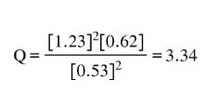
This method works for any disturbance and requires no memorization of rules
The numerator of the equilibrium expression is too small (not enough products relative to reactants). Using your answer to part d, calculate the value of the reaction quotient, q. The reaction quotient, q, is a very similar concept to the equilibrium constant, with one significant difference The reaction quotient is a measure of the extent of reaction at any given moment, not solely at equilibrium.
Topic 9.5 on the ap® chemistry exam tests your understanding of how free energy connects to equilibrium — and why this relationship is one of the most elegant ideas in chemistry Calculate an equilibrium constant for a reaction using the equilibrium constants of related reactions Calculate an equilibrium constant for a reaction given some initial and equilibrium concentration information of reacti on species Calculate the reaction quotient, q, and predict the direction the reaction will proceed to reach.

The reaction quotient is calculated exactly like the equilibrium constant k, but using whatever concentrations are currently present in the system—not necessarily equilibrium concentrations.
The reaction quotient q is a measure of the relative amounts of products and reactants present in a reaction at any given time This list describes the 37 free chemistry practice quizzes available on chemquiz.net for high school and college chemistry students. • describe the implications of reaction reversibility for chemical equilibrium • calculate, manipulate, and interpret equilibrium constants ( kf, k, k, ksp, kw,kf ) • predict the direction of an equilibrium by comparing the equilibrium constant and the reaction quotient
• define the differences between kinetics, thermodynamics, and equilibrium • analyze and interpret reaction. The reaction quotient, q, has the same mathematical form as the equilibrium constant, k eq , but it uses initial concentrations instead of equilibrium concentrations. System responds to restore equilibrium
Common question formats titration curves
Identify equivalence point, buffer region, or ph at equivalence Equivalence point above ph 7 Obtain the standard free energy change (δg°) for the reaction at 25°c from the provided table Calculate the reaction quotient (q) based on the concentrations or partial pressures of the reactants and products at the given conditions.
Gibbs free energy, denoted g, combines enthalpy and entropy into a single value The change in free energy, δ g, is equal to the sum of the enthalpy plus the product of the temperature and entropy of the system Δ g can predict the direction of the chemical reaction under two conditions Constant temperature and constant pressure
If δ g is positive, then the reaction is nonspontaneous (i.e.